Famous Found-Object Artists: From Picasso to Now
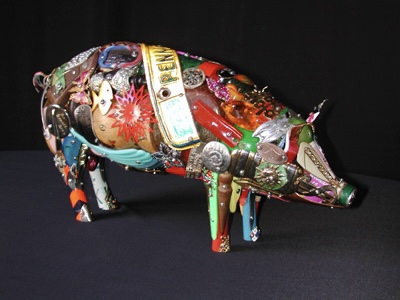
The most famous found-object artists include Pablo Picasso, Marcel Duchamp, Kurt Schwitters, Joseph Cornell, Louise Nevelson, and Robert Rauschenberg — the makers who, across the twentieth century, turned ordinary manufactured things into serious art. Found-object art is sculpture and assemblage built not by carving or casting but by selecting existing objects and combining them into something new. Leo Sewell, a Philadelphia found-object sculptor, is a living heir to that lineage: where a historic readymade asks you to reconsider one object, a Sewell sculpture fastens thousands of cast-off objects into a single, recognizable figure.
Key takeaways
- Found-object art descends from a clear line of artists — Duchamp's readymade, Picasso's assemblage, Schwitters' scrap collages, Cornell's boxes, Nevelson's walls, Rauschenberg's Combines.
- The common move isn't craft in the traditional sense — it's selection: recognizing that an existing object can carry meaning once an artist chooses it.
- "Assemblage" is the three-dimensional, many-object branch of the idea — the tradition where Leo Sewell works.
- Sewell studied this history directly, writing a master's thesis on the found object in Dada and Surrealism, then spent fifty years and 4,000+ works answering it in three dimensions.
- See the lineage continued in the recent work, or commission a piece of your own.
Who invented found-object art?
No single person invented it, but two names anchor the story: Marcel Duchamp and Pablo Picasso. Duchamp gave the idea its most radical form. The term readymade was first used by French artist Marcel Duchamp to describe the works of art he made from manufactured objects — an ordinary thing, chosen and declared art, essentially unaltered. The provocation was permanent: if the artist selects it, does craft still matter?
Picasso opened a parallel path — combining objects rather than presenting one. The use of assemblage as an approach to making art goes back to Pablo Picasso's cubist constructions. His most quoted example is Bull's Head, which is a found object artwork by Pablo Picasso, created in 1942 from the seat and handlebars of a bicycle. Two discarded bicycle parts, joined, read instantly as a bull — the whole logic of found-object art compressed into one object.
What is assemblage, and who made it famous?
If the readymade is one object, assemblage is many. In the museum sense, assemblage is art that is made by assembling disparate elements — often everyday objects — scavenged by the artist or bought specially. It is, in effect, collage stood up into three dimensions and built from things rather than pictures.
Kurt Schwitters carried the idea early and far. In 1918 the Dada artist Kurt Schwitters began to use scavenged scrap materials to create collages and assemblages — bus tickets, wrappers, broken wood — an entire personal universe he built from other people's rubbish.
Louise Nevelson made assemblage monumental and unified. Nevelson's most notable sculptures are her wooden, wall-like, collage-driven reliefs consisting of multiple boxes and compartments that hold abstract shapes and found objects from chair legs to balusters. Painted a single color — often black — her found scraps dissolve into architecture. It's a useful counterpoint to Sewell's approach: Nevelson unifies found objects by erasing their color under monochrome paint, while Sewell keeps every object's original color and lets the surface stay legible as its parts.
Which artists turned junk into icons?
Two more names complete the core roster, and both bent found objects toward the personal and the everyday. Joseph Cornell worked small and dreamlike. Cornell's most characteristic art works were boxed assemblages created from found objects — glass, maps, feathers, cut-outs, arranged inside shadow boxes like private theaters. He proved that found-object art could be intimate and poetic, not only provocative.
Robert Rauschenberg blew the scale back open and gave the impulse a new name. A Combine is an artwork that incorporates elements of both painting and sculpture; the term is most closely associated with the artwork of American artist Robert Rauschenberg, who coined it for works that drag real-world objects — a quilt, a tire, a stuffed bird — directly into painting. Between Cornell's boxes and Rauschenberg's Combines, the found object had become one of the central materials of modern art.
What unites these figures across the century is a single reversal: the artist's decisive act moves from making to choosing. Duchamp chooses; Picasso joins; Schwitters hoards and arranges; Cornell frames; Nevelson unifies; Rauschenberg absorbs. Each proves the same point in a different key — that a manufactured object, lifted out of its ordinary use and set in the context of art, can carry meaning as surely as a brushstroke. That shared insight is the through-line that connects a welded bicycle seat to a Philadelphia studio decades later.
Where does Leo Sewell fit among found-object artists?
Unusually directly — because he studied the tradition before he extended it. Long before the sculptures, there was the scholarship: Sewell wrote a master's thesis on the Use of the Found Object in Dada and Surrealism. So the practice isn't a stylistic accident. It's an artist who studied why the found object matters in modern art, then spent decades answering the question in three dimensions.
His contribution to the lineage is density and subject. Historic readymades tend toward the singular and the deadpan; Sewell's assemblages are exuberant and naturalistic — thousands of recognizable objects resolved into living forms. He works at volume, too: Sewell has produced over 4,000 works over the last 50 years, and his assemblages of recycled material are in over 40 museums and in private collections worldwide. That turns a conceptual lineage into a sustained, recognizable body of work.
The materials keep him firmly in the found-object tradition rather than the art-supply store. His collage-like sculpture is assembled from metal, wood, and plastic that he collects from trash, yard sales, and flea markets — the same scavenging instinct that runs from Schwitters' scrap to Rauschenberg's street finds. His own words compress the whole tradition into a working philosophy: "I make order out of chaos. Everything I use was made by someone, used by someone, and thrown away by someone. I give it one more life." That is Duchamp's provocation turned generous — selection not as irony, but as rescue.
How can you see, or commission, found-object sculpture today?
The fastest way to understand found-object art is to stand in front of a piece until the surface breaks apart into individual objects and then reassembles into its subject — an effect a photograph flattens and a screen can't reproduce. The living end of the tradition described here is on view in Leo Sewell's recent work, where a duck, a bear, or a pig turns out, up close, to be hundreds of toys, tools, keys, and fragments of chrome.
And unlike the historic works — which live in museums — a Sewell assemblage is something you can also commission. If you'd like a found-object sculpture of your own subject, at your own scale, the Philadelphia studio takes commissions: you describe the subject and setting, and a piece is built to order using the same additive, hand-assembled method that produced fifty years of work. It's the rare chance to own a living piece of a century-deep lineage, made new from the discarded world.