Found-Object Art in Philadelphia: Where to Look
Philadelphia is one of the best cities in the world to encounter found-object art. The Philadelphia Museum of Art is home to the world's largest Duchamp collection — the artist who invented the readymade, the idea the whole tradition rests on. On South Street, Philadelphia's Magic Gardens preserves a mosaicked environment built from bottles, tiles, bicycle wheels, and mirror. And the city sustains a living practice of it: the Dumpster Divers collective, and the studio of found-object sculptor Leo Sewell, who has been assembling salvaged metal, wood, and plastic here since 1974.
Key takeaways
- Philadelphia holds both ends of the found-object tradition: Duchamp's readymades in a museum, and working studios still making the stuff.
- The Philadelphia Museum of Art has the world's largest collection of work by Marcel Duchamp.
- Philadelphia's Magic Gardens is a mosaicked environment made almost entirely from salvaged material.
- The city has an unusually old civic commitment to public art — its public-art association dates to 1872, and the Percent for Art model was pioneered here in 1959.
- Leo Sewell has worked as a Philadelphia found-object sculptor since 1974; see the recent work or commission a piece.
Why does Philadelphia have so much art made from cast-offs?
Because the city was built for it, in two different senses. Philadelphia is a maker's town — row-house workshops, flea markets, stoop sales, and a long, unglamorous habit of reuse. Found-object art is the art form that habit produces: made by hand, from what's already here, valuing ingenuity over expense.
The second reason is civic. Philadelphia has treated public art as public infrastructure for longer than almost anywhere else in the country. The Association for Public Art was founded as the first private nonprofit organization in the United States dedicated to placing art in public spaces — established in 1872 by two civic-minded young men, Henry K. Fox and Charles Howell. Nearly a century later the city set another precedent: the ground-breaking Percent for Art model was pioneered in Philadelphia in 1959 and has been replicated in cities across the country.
Put those together and you get a place where art out in the open is normal, and where the raw material of found-object work — other people's discards — is abundant. That combination is rarer than it sounds.
Where can you see found-object art in Philadelphia?
The most concentrated experience is Philadelphia's Magic Gardens, the nonprofit organization that preserves and interprets the artwork of Isaiah Zagar. It is a full environment rather than a single object — walls, walkways, and a bi-level outdoor garden surfaced entirely in mosaic.
What makes it found-object art rather than decoration is the source of the material. Zagar used handmade tiles, bottles, bicycle wheels, mirror, and international folk art to chronicle his life and influences. The mosaic isn't a picture of a life; it's assembled out of the objects of one. And the scale of the habit is remarkable: he mosaicked more than 200 walls and buildings over 50 years, which means fragments of the practice turn up across the city, not only at the South Street site.
That's the useful thing to know about looking for found-object art in Philadelphia generally: a lot of it isn't in galleries. It's on walls, in lobbies, in parks, and in the collections of institutions that don't advertise it as a category.
What does Marcel Duchamp have to do with Philadelphia?
More than most visitors expect. The Philadelphia Museum of Art is home to the world's largest Duchamp collection, holding what the museum describes as the most significant assembly of works by Duchamp along with the most extensive archives relating to his life and work.
That matters because Duchamp is where this all starts. The term readymade was first used by French artist Marcel Duchamp to describe the works of art he made from manufactured objects — an ordinary thing, selected and declared art, essentially unaltered. Every artist who has since picked something out of a gutter and called it material is working downstream of that gesture. (For the longer version of that history, see what found-object art is and where it came from.)
His last major work landed here too: Duchamp's widow and step-son installed the work and made it available to the public at the Philadelphia Museum of Art in 1969, a year after his death. So the city that hosts a living found-object practice also holds the archive of the idea that made it possible — an unusual pairing, and a genuinely good reason to spend a day looking.
Who are the Philadelphia Dumpster Divers?
They're the organized form of the city's salvage instinct: an artists' group devoted to making work from reclaimed material. Leo Sewell is a member and co-founder of the artists' group called the Philadelphia Dumpster Divers.
The existence of the group is the point. Plenty of cities have an individual artist working with junk. Philadelphia has a collective — which tells you the practice here isn't an eccentricity but a culture, with shared sources, shared standards, and decades of continuity behind it.
Where does Leo Sewell fit into the city's found-object tradition?
Squarely in the middle of it, and with an unusual claim: he studied the tradition before he extended it. Long before the sculptures, Sewell wrote a master's thesis on the Use of the Found Object in Dada and Surrealism — the exact lineage the Duchamp holdings across town represent. Then he moved to Philadelphia and spent fifty years answering it in three dimensions.
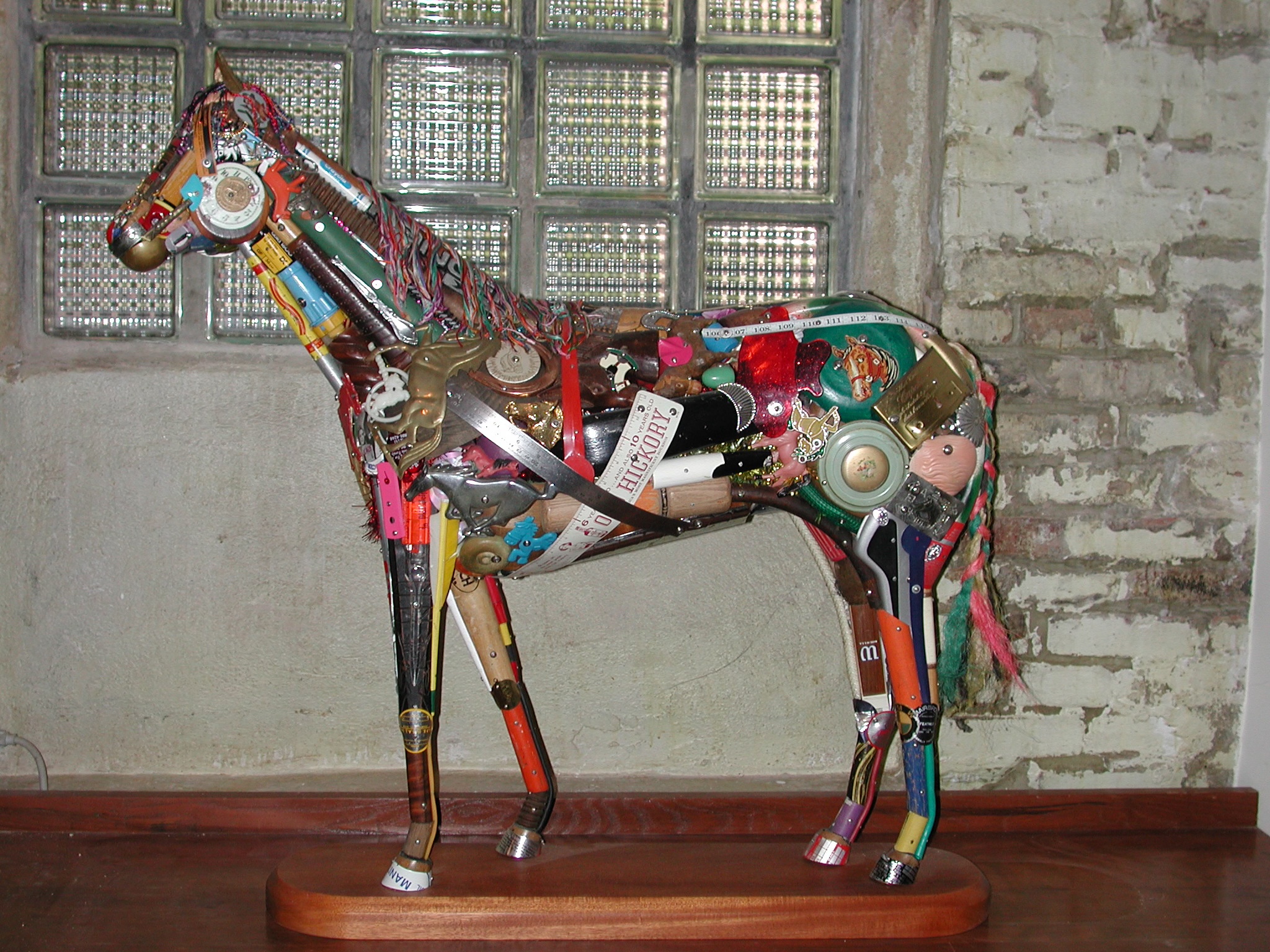
The material comes from the city itself. His collage-like sculpture is assembled from metal, wood, and plastic that he collects from trash, yard sales, and flea markets — Philadelphia's cast-offs, fastened into ducks, bears, figures, and portraits. His own statement of what that means is compact: "I make order out of chaos. Everything I use was made by someone, used by someone, and thrown away by someone. I give it one more life."
The output has travelled a long way from the neighborhoods that supplied it. His assemblages of recycled material are in over 40 museums and in private collections worldwide, and his public work runs to civic scale — including a forty-foot Statue of Liberty hand and torch. The volume is such that even the artist has lost count; as he puts it in his own CV: "To date, I have made over 3,600 sculptures, and could only account for about 100 of them."
That last line is worth reading twice, because it describes something true of found-object art in Philadelphia in general. The work disperses. It goes into lobbies, children's museums, private homes, and public plazas, and no single map holds all of it. For the fuller picture of one practice inside the city, see Leo Sewell: Philadelphia's found-object sculptor.
How do you commission a found-object sculpture in Philadelphia?
Seeing the tradition is one route; adding to it is another. Sewell's Philadelphia studio takes commissions, and being in or near the city has practical advantages — larger installations can be coordinated and sited in person, while pieces for collectors farther afield are crated and shipped.
The subject is open: animals, figures, portraits, mascots, or a work built around objects with personal or institutional meaning. If you have an idea, start on the commissions page. If you'd rather see the range first, spend some time with the recent work — and then go stand in front of one in person, because the surface only breaks apart into individual objects when you're close enough to touch it.