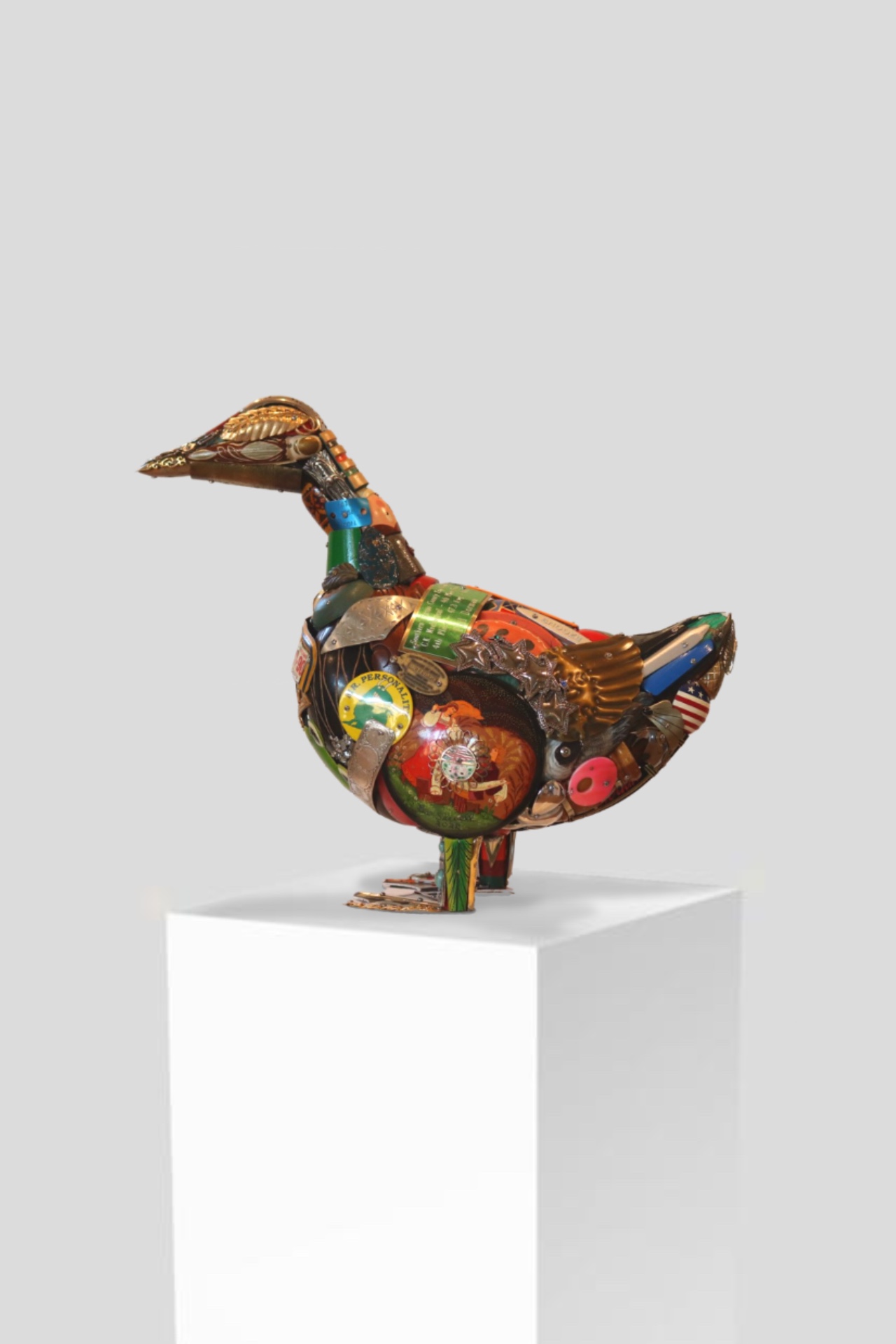
Outdoor Found-Object Sculpture: Will It Last?
Yes — found-object sculpture can be displayed outdoors, provided the piece is built for it. Whether a Leo Sewell assemblage can live in a garden, a courtyard, or an open lobby comes down to how it's made: works built from weather-durable materials and joined with corrosion-resistant stainless fasteners or welding hold up well outside, while a piece assembled for indoor display may not be weatherproofed. The surest route to an outdoor found-object sculpture is to commission one for the setting, or to ask the Philadelphia studio whether a specific work suits the location you have in mind.
Key takeaways
- Found-object sculpture can go outdoors when it's built for it — the deciding factors are materials and construction, not the medium itself.
- Leo Sewell's studio assembles its work with stainless fasteners or welding, and chooses objects partly for durability and patina — both of which favour outdoor life.
- Weathering isn't only a risk here: with assemblage made from already-used objects, an evolving patina usually reads as character.
- The safest outdoor piece is a commissioned one, engineered for its site from the start.
- Not sure about a specific sculpture? Ask the studio before placing it outside.
Can a found-object sculpture go outside?
The short answer is that the medium is no barrier — the construction is what matters. A found object, in the museum sense, is simply "a natural or man-made object, or fragment of an object, that is found (or sometimes bought) by an artist and kept because of some intrinsic interest the artist sees in it." Nothing in that definition is inherently fragile or inherently weatherproof; a found-object sculpture is exactly as durable as the objects and joins it's built from.
That's why the honest answer to "can it go outside?" is it depends on the piece. A sculpture assembled for a shelf or a display case hasn't necessarily been detailed for rain, frost, and ultraviolet light. A sculpture built for a garden or a plaza can be. The difference is a set of decisions made during the build — which is exactly why an outdoor placement is best planned, not improvised after the fact.
What makes a found-object sculpture weather well?
Two things: what it's made of, and how it's held together.
On materials, Leo Sewell's objects are "selected for their color, shape, texture, durability, and patina." Durability and patina are both weather-relevant. Durability is self-explanatory; patina — the settled surface of aged metal — describes objects that have already lived in the world and taken on a stable, weathered finish. As a general rule, metals such as brass, chrome, and stainless steel tend to weather comparatively well outdoors, while untreated wood and some plastics degrade faster under sustained sun and moisture. A piece intended for outdoor life leans on the former.
On construction, the studio states that its reclaimed objects are assembled by stainless fasteners or by welding. That matters outside for a simple reason: stainless steel resists corrosion, and a welded or mechanically fastened joint doesn't rely on adhesives that sun and damp can defeat. More broadly, Sewell uses "nails, bolts and screws" to assemble the work — genuine structural fixing rather than glue-and-hope. The result is an object engineered to stay together, which is the first requirement of anything meant to live outdoors.
Do found objects and patina help outdoors?
Unusually, yes — and this is where found-object sculpture differs from a pristine painted object. Weathering is often the enemy of outdoor art; here it's frequently an ally. The material is already a record of use, so a little more exposure tends to deepen the effect rather than spoil it.
Leo Sewell's own philosophy frames the point. As his artist statement puts it: "I make order out of chaos. Everything I use was made by someone, used by someone, and thrown away by someone. I give it one more life." Objects that carry that history wear further weathering more gracefully than a factory-fresh surface would — a scuff or a shift in tone reads as continuity, not damage.
That said, "ages gracefully" is not the same as "indestructible." Outdoor exposure is real, and different materials in a mixed-media surface respond differently. The point isn't that the work is immune to the weather; it's that, built correctly, it's designed to weather well — and that's a design decision worth making up front.
How large can an outdoor sculpture be?
Scale is rarely the obstacle, because the method is fundamentally structural and scales cleanly. Using nails, bolts, and screws, Sewell has assembled work across an enormous range — "a house cat and other animals, a life-size lady and other figures, a forty-foot Statue of Liberty hand and torch and other installations." A tabletop animal and a monumental installation are built on the same principle: objects fastened to a sound internal form.
For an outdoor commission, that span is the encouraging part. A garden animal, a courtyard figure, or a large architectural centerpiece are all within the practice, and larger outdoor pieces simply demand more engineering — a more robust armature, more attention to weight, balance, and drainage — rather than a different approach. This is also why the work turns up in demanding public and corporate settings: his assemblages are held in over 40 museums and in private collections worldwide, and corporate collectors have included NBC and Nike. Work that performs in those environments is work built to a serious standard.
How do you care for an outdoor found-object sculpture?
Even a piece built for outdoors benefits from a little stewardship. A few sensible habits:
- Site it thoughtfully. Good drainage under the base and some shelter from the harshest exposure go a long way; standing water and constant driving rain are harder on any material than open air.
- Keep it clean. Rinse off grit and dust gently and let it dry; avoid harsh solvents that could react with a mixed metal, wood, and plastic surface.
- Check the fixings. Once or twice a year, confirm the base is stable and the joints and fasteners remain sound — the same structural attention the piece was built with.
- Let the patina be. Some change in surface is expected and usually welcome. Resist the urge to "restore" a weathered finish to factory brightness.
For anything beyond routine care — a repair, a move, or a question about a specific material in your piece — ask the studio through the contact page before improvising. Advice specific to your sculpture and your climate will always beat a general rule. You can see the range of subjects and finishes in the recent work, which helps when picturing how a piece will read in a particular outdoor spot.
How do you commission an outdoor piece?
If you know you want a sculpture for a garden, terrace, courtyard, or public space, commissioning is the cleanest path — because outdoor performance gets engineered in from the first sketch rather than hoped for afterward. The commissions page walks through it: you describe the subject, the scale, and crucially the location, and the studio plans materials, weight, balance, and durability around that setting.
This is the practical advantage of a made-to-order approach. An indoor piece adapted to the outdoors is a compromise; a piece designed for the outdoors is engineered for it. With more than fifty years and thousands of works behind the method, an outdoor commission isn't an experiment — it's the latest instance of a practice that already spans the tabletop to the monumental.
To begin, describe your setting and subject on the commissions page, or browse the recent work first to find the direction you're drawn to. Either way, the studio will tell you honestly what a given piece needs to thrive in the open air.